
1. What Is a Biochip? How This Small but Powerful Technology Works
A biochip is a miniature testing device made from materials such as silicon wafers, glass, or polymers, including plastics, combined with microelectromechanical systems (MEMS) and automation technologies. Its key advantages—high accuracy, fast testing, and low sample requirements—make it an important tool in clinical diagnostics, genetic testing, and medical research.
In the past, gene expression studies could examine only one or a few genes at a time. Testing multiple types of samples required considerable research time and human resources. Today, biochips help researchers test large numbers of samples quickly, reduce costs, and obtain highly accurate results.
Biochips work by using probes and detection sites on the chip to bind to target molecules in a sample, such as DNA, RNA, or proteins. When specific biomolecules are present, they trigger physical or chemical responses, including changes in electrical current, optical signals, or color. The system analyzes these responses and converts them into data, helping physicians and researchers understand the status and concentration of target molecules.
2. Four Key Features of Biochips—and Their Potential in Biomedicine
Biochips can perform extensive analyses in a short time, improving efficiency and accuracy compared with conventional testing while reducing sample consumption. Here are their four core features.
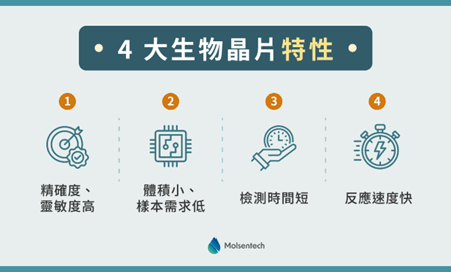
1. High Accuracy and Sensitivity
Biochips contain a large number of densely arranged detection sites, each capable of reacting with a specific target molecule. Even at low biomolecule concentrations, they can identify target genes or pathogens with high sensitivity. This can substantially reduce false positives and false negatives and improve diagnostic accuracy.
2. Compact Size and Low Sample Requirements
Conventional testing techniques often require large samples to detect target molecules. Biochips use miniaturized structures to perform complex biological analyses on a very small platform. By greatly reducing the distance between reactants, they require only tiny sample volumes, minimizing specimen waste and lowering experimental and testing costs.
3. Short Testing Times
Biochips offer high-throughput testing, analyzing thousands to tens of thousands of biomarkers simultaneously. This overcomes the limitations of conventional methods that test only one or a few biomarkers at a time, helping healthcare institutions understand disease progression sooner and accelerate research.
4. Rapid Reactions
Fast reactions are another defining feature of biochips. Biomolecule detection and data analysis can be completed quickly, significantly improving testing efficiency and supporting more effective biomedical research, disease diagnosis, and clinical decision-making.
Molsentech’s highly sensitive technology is advancing a new era of precision testing.
3. What Types of Biochips Are Available? Two Ways to Classify Them
Biochips can be classified by their structure or function. The following overview explains both approaches to help you understand their capabilities and potential.
(1) By Structure: With or Without Semiconductor Components
1. Biochips with Semiconductor Components
These biochips combine semiconductor technology with biological detection to improve sensitivity and data processing capabilities. Common applications include genetic testing, protein analysis, and disease diagnosis.
Molsentech’s biochips, for example, use semiconductor components called field-effect transistors (FETs) to detect changes in electrical current at the chip surface. When biomolecules such as DNA or proteins come into contact with the probes, they alter the electric field distribution and change the current signal. These signals are then used to generate test reports, enabling highly sensitive and rapid testing.
2. Biochips without Semiconductor Components
These biochips do not use semiconductor electronic components. Instead, they rely on microfluidic technology or biomimetic structures to simulate biological systems for analysis or diagnosis. Examples include microfluidic chips and organ-on-a-chip devices, with applications in drug development and testing, personalized medicine, and other fields.
(2) By Function: Microarray Chips and Microfluidic Chips
1. Microarray Chips
Microarray chips feature a simple structure and an orderly arrangement. Their core technology places large numbers of specific biological probes, such as DNA, RNA, or protein molecules, on a tiny chip. Higher probe density improves precision. When target molecules in a sample bind to the probes, a fluorescent signal is generated. Optical scanning equipment quantifies the signal, rapidly producing large amounts of data for precise testing.
Key advantages include fast testing, convenient operation, and the simultaneous analysis of thousands to tens of thousands of data points. Compared with traditional methods, microarrays offer lower costs and considerable potential for automation, making them increasingly important in biomedical research and clinical applications.
Most microarray chips currently serve as detection chips, including gene chips and protein chips. Widely used in pathogen detection, genetic testing, drug development, and vaccine research, they are among the most common types of biochips.
2. Microfluidic Chips
Microfluidic chips contain tiny etched channels that precisely control the movement of liquid samples for complex processing and analysis. These processing chips are commonly used in gene expression analysis, drug screening, disease diagnosis, and food safety. Their advantages include low cost, high precision, and very short reaction times.
However, narrow channels can become clogged by specimens, and the technical requirements are relatively demanding, limiting large-scale adoption. To address this challenge, Molsentech’s biochips use heterogeneous stacked packaging technology. This substantially reduces adhesion-related clogging as samples flow through the chip, minimizes sample loss, and improves testing efficiency and reliability.
Molsentech biochips deliver more sensitive, faster test results.
4. What Are Biochips Used For? Six Major Applications
Biochips have a wide range of applications, including medical research, disease testing, and food and environmental monitoring. The following examples highlight the potential of this forward-looking technology.
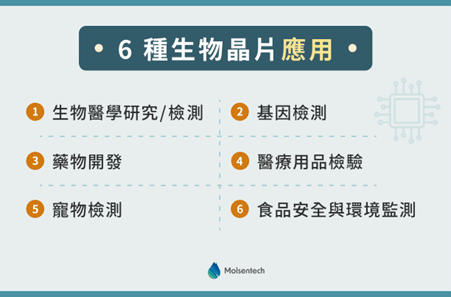
Biomedical research and testing: Biochips help healthcare institutions assess individual gene and protein expression. They have broad value in disease research and screening, including cancer genetic testing, dementia, and various infectious diseases. Rapid detection of infection can help prevent disease spread, while pathogen identification supports appropriate medical intervention.
Genetic testing: Biochips are important tools for identifying potential health risks and inherited conditions, such as thalassemia and hypertension, helping individuals strengthen ongoing health monitoring. They can also help predict drug responses, reduce side effects, and support personalized medication.
Drug development: Biochips provide extensive biological information that helps developers understand drug mechanisms and potential problems, improving the prospects of successful new drug development.
Testing of medical products: Biochips can rapidly detect pathogens in medical products, supporting early identification of contamination and timely action. For example, testing for mycoplasma contamination—a common concern in cell therapy and biopharmaceutical production—can help reduce product losses.
Pet testing: Biochips can also be used in animals, helping owners and veterinarians understand potential disease risks and plan preventive care and medical treatment early.
Food safety and environmental monitoring: Biochips can monitor harmful substances in food and the environment, including pesticide residues, heavy metal contamination, and allergens, supporting public health and food safety.
5. A New Tool for Precision Testing: Molsentech Biochip Technology
In conventional biological testing and analysis, high accuracy often comes with lengthy testing times and complex procedures. These can delay treatment, increase testing costs, and add to the emotional burden on patients waiting for results.
With continued technological progress, Molsentech has developed biochips that combine speed with accuracy. Rapid results help healthcare institutions make diagnoses sooner, while highly sensitive detection using only tiny samples maximizes the value of each specimen. Our technology offers three key advantages.
✨ Improved Diagnostic Accuracy
Our biochips incorporate advanced manufacturing processes to achieve a high-density layout of more than 10,000 detection sites. They can carry multiple types of biological probes simultaneously, substantially improving the precision of genetic testing results.
✨ Lower Labor and Time Costs
We independently developed the world’s first testing instrument to integrate electrical current signals with an automated fluidics system. It processes biological current signals from more than 10,000 detection sites per second and generates accurate results in real time. This enables healthcare institutions to provide analysis reports to patients sooner, significantly reducing labor and time costs and improving healthcare efficiency.
✨ Consistent Chip Quality
Our proprietary biological coating technology stabilizes molecular arrangement to improve testing reliability and sensitivity. Because biological sample testing demands stability and efficiency, we also use heterogeneous stacked packaging technology to reduce adhesion and clogging as specimens flow through the chip. Our COVID-19 nucleic acid testing chip has received Emergency Use Authorization (EUA) from the Taiwan Food and Drug Administration (TFDA), outperforming existing competing brands in the market.
Founded in 2014, Molsentech is committed to making precision testing simpler. We develop semiconductor biochip testing platforms that use nanoscale devices as sensors, drawing on extensive expertise in biochip development and the hardware and software of testing equipment. We aim to make precision testing faster and more accessible, advance medical technology in Taiwan, and create greater hope for public health.
Molsentech’s highly sensitive technology is advancing a new era of precision testing.
