

I. Don't Ignore Pet Health Checkups: The Secret to Longevity for Your Pets
(1) Why Do Pets Need Health Checkups?
Did you know? Pets age much faster than humans, with an average lifespan only 1/5 to 1/7 of ours. In other words, 1 year of a pet's life is roughly equal to 7 human years, silently bringing them into middle age before you know it. Furthermore, because pets cannot verbally express physical discomfort, abnormal signs often appear only after symptoms worsen. This can lead to delayed treatment, impacting a pet owner's daily life, emotions, and finances.
Therefore, we recommend that pet owners regularly bring their pets for health checkups to fully understand their physical condition. This enables veterinarians to adopt appropriate treatment strategies so pets can live healthier, longer lives.
(2) How Often Should Pets Get a Health Checkup? Recommended Frequency for Cats and Dogs
For both cats and dogs, if any abnormalities or discomfort occur, schedule a health checkup immediately so a veterinarian can determine treatment options or decide whether more detailed examinations are necessary.
If your pet behaves normally with no obvious discomfort in daily life, routine wellness examinations based on age are recommended:
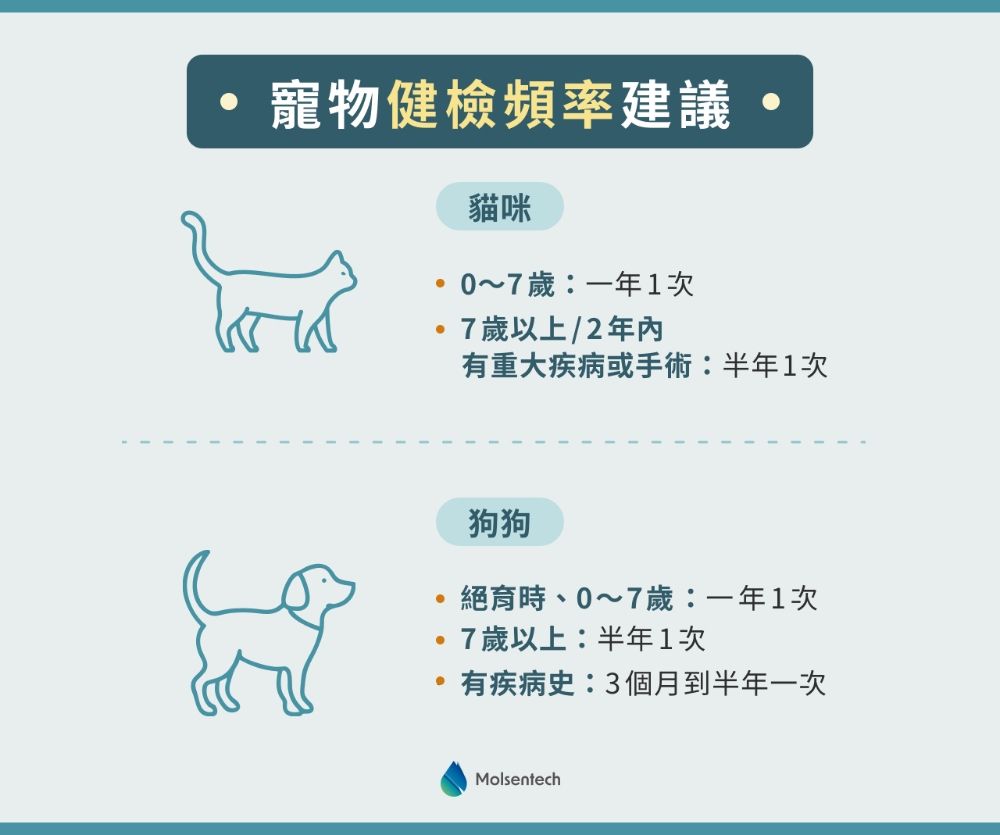
✅ Recommended Health Checkup Frequency for Cats
- 0–7 years old: Once a year
- 7+ years old / major illness or surgery within 2 years: Once every 6 months
✅ Recommended Health Checkup Frequency for Dogs
- When neutered/spayed, 0–7 years old: Once a year
- 7+ years old: Once every 6 months
- History of disease: Once every 3 to 6 months
※ The actual frequency should be thoroughly discussed with a veterinarian based on factors such as the pet's age, breed, and health condition to formulate a tailored wellness examination plan.
Major upgrade in pet health checkup technology: Choose Molsentech's biochip technology.
II. Pet Health Checkup Items | Recommended Screening Items for Cats and Dogs at a Glance
To comprehensively evaluate a pet's health, prior to the wellness examination, veterinarians usually ask for basic information such as the pet's age, breed, sex, dietary habits, activity level, abnormal behaviors, and medical history. They then perform a series of tests based on the pet's specific condition. Below are 6 basic health checkup items applicable to both cats and dogs:
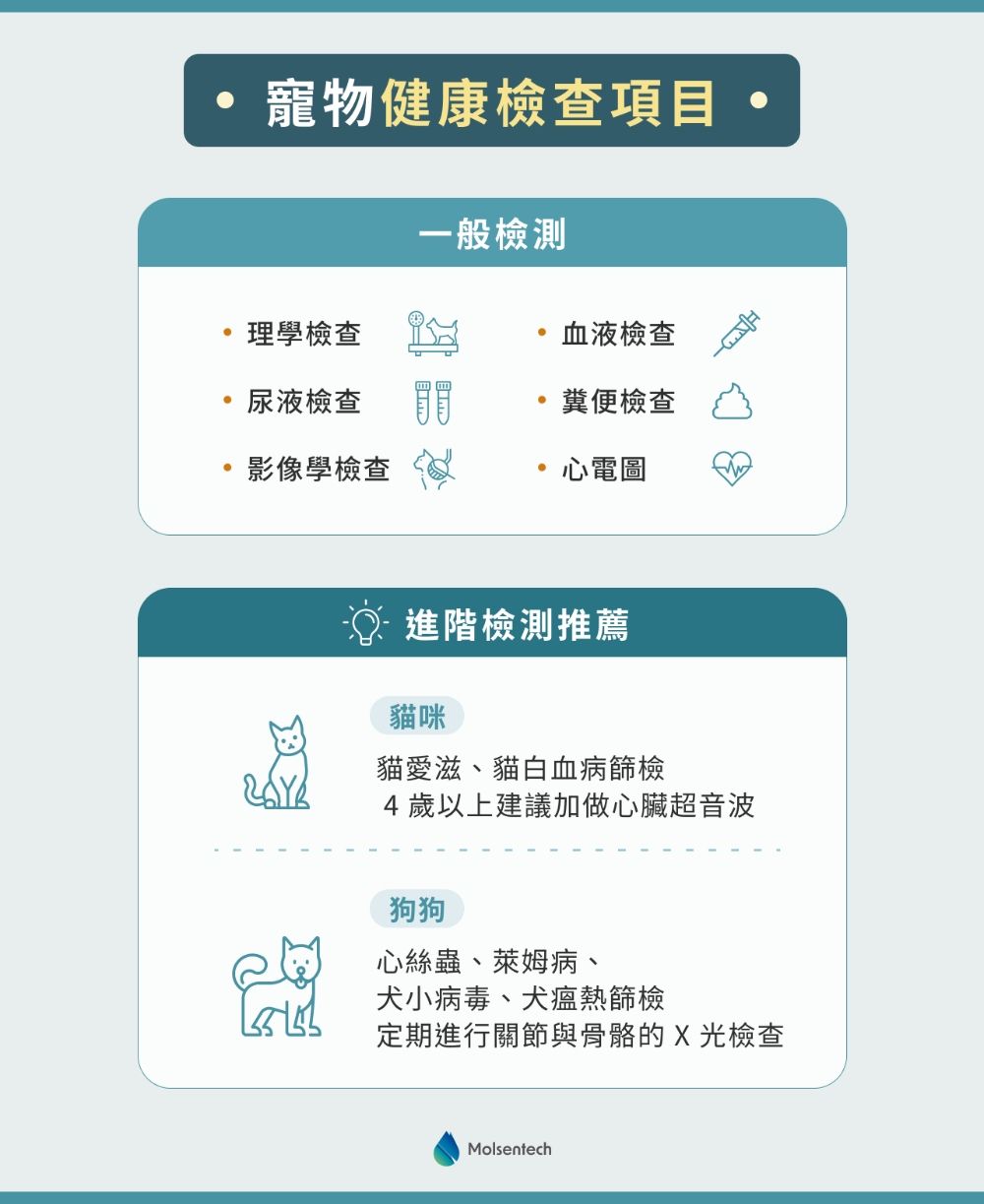
1. Physical Examination
Physical examination refers to veterinarians using visual inspection, palpation, or simple tools to determine if a pet shows external abnormal signs. Evaluated parameters include limbs, coat, gait, body temperature, weight, vision, teeth, joints, respiratory rate, and presence of skin masses/lumps.
2. Blood Test
Blood tests are a key item for diagnosing pet health. Blood samples help veterinarians observe health metrics that are difficult to detect with the naked eye, including red and white blood cell counts, liver and kidney function, blood glucose, and endocrine system abnormalities. In addition, measuring a pet's blood pressure helps determine whether high or low blood pressure is present.
3. Urinalysis
Checking urine color, pH, protein, and other parameters helps veterinarians observe whether organs such as the urinary tract, kidneys, liver, and pancreas have issues like infections, inflammation, stones, or tumors.
4. Fecal Examination
Pet stool contains a wealth of health information. Characteristics like fecal morphology, color, odor, and bacteria help veterinarians understand gastrointestinal health and check for intestinal parasite infections.
If you notice abnormal bowel movements, take photos or bring a stool sample to the veterinary clinic to help the veterinarian understand the situation.
5. Medical Imaging
Imaging is a non-invasive medical examination method that helps veterinarians observe internal structures, organ function, and potential lesions in pets. Common methods include X-rays and ultrasound.
X-rays primarily check bones and joints for fractures or tumors, and evaluate cardiac silhouette size to assess for cardiomegaly (enlarged heart). Ultrasound allows inspection of thoracic and abdominal organs for abnormal lesions, as well as blood flow velocity in the heart to evaluate cardiac valve function and myocardial contractility.
6. Electrocardiogram (ECG)
Although X-rays and ultrasound evaluate heart structure, an ECG is recommended to comprehensively evaluate the electrical activity of the heart (signals for cardiac muscle contraction and relaxation), detecting arrhythmias and measuring heart rate and cardiac conduction function.
If abnormalities are found during basic checkups, the following advanced items are recommended:
🐱 Advanced Health Checkup Items for Cats
- To comprehensively maintain cat health, blood tests screening for infectious diseases such as FIV (Feline Immunodeficiency Virus) and FeLV (Feline Leukemia Virus) are recommended.
- For cats aged 4 and older, an echocardiogram (cardiac ultrasound) is recommended to screen for hypertrophic cardiomyopathy (HCM).
🐶 Advanced Health Checkup Items for Dogs
- Common canine diseases such as heartworm, Lyme disease, canine parvovirus, and canine distemper are recommended for screening via additional blood test items.
- Large dog breeds are prone to hip dysplasia, while small dog breeds frequently experience patellar luxation. Regular X-rays for joints and bones are recommended.
※ Every pet's body condition is unique and requires specific examinations based on the veterinarian's professional judgment.
Traditional pet wellness exam techniques require larger sample volumes, increasing pet stress, prolonging test times, and potentially delaying critical treatment windows. Molsentech has developed high-efficiency biochips dedicated to pet health checkups, requiring only tiny sample amounts to rapidly analyze physiological data in pets—significantly increasing sensitivity while reducing testing time and costs.
The ultimate solution for pet health checkups: Choose the more reliable and sensitive "Molsentech".
III. Safeguarding Pet Health Starts with You! 3 Key Precautions for Pet Owners Before Checkups
To ensure more accurate health checkup results, pet owners are advised to follow these 3 key precautions:
- List your pet's health status: Before the checkup, note daily observations such as diet, stool appearance, energy level, water intake, and any vomiting, itching, or hair loss. This helps the veterinarian understand your cat's or dog's current condition.
- Fast for 8 hours prior to checkup: To ensure accurate blood test results, fast your pet for at least 8 hours before examination. Water is permitted to ensure sufficient volume for urinalysis.
- Avoid excessive exercise: On the day of the checkup, keep your pet rested and avoid excessive running or excitement, which can elevate heart rate and respiratory rate, thereby affecting the accuracy of blood and ECG tests.
IV. How Much Does a Pet Health Checkup Cost? Fee Overview for 9 Pet Checkup Items
According to the fee schedule announced by the Taipei Veterinary Medical Association, the upper limits for pet health checkup fees are as follows:
- General Consultation Fee: NT$800
- Microscopic Skin & Coat Inspection: NT$300
- Microscopic Fecal Examination: NT$300
- Microscopic Urinalysis: NT$500
- Blood Test: NT$250 – NT$3,000
- Blood Pressure Measurement: NT$500
- Infectious Disease Screening: NT$1,500
- X-ray Examination: NT$500 – NT$3,000
- Ultrasound Examination: NT$2,000 – NT$10,000
※ Health checkup costs for dogs and cats vary based on breed, size, and age, and individual clinics may have different pricing standards. Actual fees are subject to announcements by respective veterinary clinics.
V. Recommended Pet Health Testing Technology: Molsentech, Safeguarding Pet Health
As pet ownership grows, pet health testing technology becomes increasingly vital. Beyond careful daily care, advanced biotechnology provides high-efficiency health checkups, achieving "early detection, early prevention/treatment" to build a reliable health fortress for pets!
Because many existing testing techniques are time-consuming, lack sensitivity, and carry high costs, Molsentech has developed dedicated biochips for pet health checkups. Offering higher sensitivity along with lower testing time and costs, this technology greatly enhances diagnostic efficiency—allowing veterinarians to comprehensively understand pet health and formulate more effective treatment and prevention strategies.
Founded in 2014 with the vision to "make precision diagnostics simpler," Molsentech is committed to developing semiconductor biochip testing platforms based on nano-device sensing. Possessing extensive experience and expertise in biochip development as well as diagnostic hardware and software, Molsentech aims to make precision testing more instant and widespread—bringing greater potential to medical technology and delivering hope for public and animal health.
Choose Molsentech biochips to give your pets superior health protection.
