

1. What Is Genetic Testing, and Why Does It Matter?
Genetic testing is an advanced approach to health analysis that examines an individual’s DNA sequence to provide deep insights into genetic traits, physical predispositions, and potential disease risks. By leveraging this information, healthcare professionals can obtain critical data to guide more precise treatment and preventive strategies—ultimately improving the efficiency and effectiveness of medical care.
Today, genetic testing has become an essential component of modern medicine. It is not only transforming how we understand health but also serving as a cornerstone of precision medicine. To promote broader accessibility, the Ministry of Health and Welfare included next-generation sequencing (NGS) in the national health insurance coverage starting May 1, 2024, enabling more individuals to benefit from genetic testing.
With continued policy support and technological advancement, genetic testing is expected to play an increasingly important role in healthcare, bringing greater benefits to overall well-being.
2. Four Key Benefits of Genetic Testing:Building a Healthier Future for You and the Next Generation
Genetic testing allows individuals to identify potential health risks in advance, enabling more precise medical interventions while safeguarding both personal and family health. Below are four key benefits:
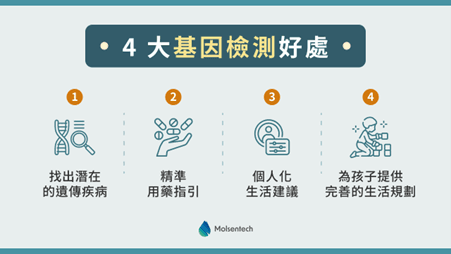
Benefit 1: Identifying Potential Genetic Risks
Genetic testing can accurately detect inherited risk factors within a family’s genetic profile. This allows individuals to take early preventive measures and strengthen health monitoring, significantly reducing the likelihood of disease development. It is important to note that test results indicate risk levels and do not guarantee that a disease will occur.
Benefit 2: Precision Medication Guidance
Genetic testing helps physicians understand how a patient metabolizes specific medications and their potential side effects. This enables healthcare providers to avoid high-risk drugs and select more suitable treatments and dosages, thereby reducing adverse reactions and improving treatment outcomes.
Benefit 3: Personalized Lifestyle Recommendations
Based on genetic insights, individuals can make informed adjustments to their lifestyle—such as improving diet, increasing physical activity, or avoiding certain environmental factors—to reduce disease risk. For example, individuals identified as having a higher risk of cardiovascular disease can adopt regular exercise routines and maintain weight control to support long-term health.
Benefit 4: Long-Term Health Planning for the Next Generation
Preconception genetic testing can help prevent the transmission of hereditary conditions to newborns. After birth, genetic testing can further assist parents in understanding their child’s genetic traits and health risks, allowing for more informed and proactive life planning.
The Role of Technology in Advancing Genetic Testing
Technological innovation continues to reshape the field of genetic testing. For instance, Molsentech’s proprietary biochip technology incorporates a unique bio-coating design that overcomes traditional limitations, offering significantly higher sensitivity compared to conventional methods. From detecting potential diseases to guiding medication and lifestyle decisions, this technology provides healthcare professionals and individuals with more precise and actionable insights—ultimately enhancing quality of life.
3. Types of Genetic Testing: Unlocking the Code to Your Health
Newborn Genetic Testing Newborn genetic testing enables early detection of inherited conditions that may affect a child’s development. Early identification allows timely medical intervention and health management, providing a strong foundation for long-term health.
Inherited Genetic Testing
For individuals with a family history of genetic diseases, inherited genetic testing can determine whether they carry disease-related genes—such as those associated with thalassemia, hypertension, or diabetes. This type of testing is also highly recommended for couples planning pregnancy, helping assess genetic compatibility and evaluate whether further embryo screening may be necessary.
Pharmacogenomic Testing
Each individual has a unique genetic makeup, which influences how they respond to medications. Pharmacogenomic testing helps predict drug metabolism and potential adverse reactions, enabling physicians to prescribe the most suitable medications and dosages. For example, if a genetic profile indicates a risk of severe skin or mucosal reactions to a specific drug, alternative treatments can be selected to reduce side effects.
Somatic Mutation Testing
Somatic mutation testing identifies acquired genetic mutations caused by environmental factors such as smoking, UV exposure, or radiation. This enables early disease detection and timely intervention, reducing the risk of disease progression.
Advancing Detection with Biochip Technology
Molsentech’s proprietary biochip technology offers exceptional sensitivity, capable of detecting genetic mutations even at extremely low concentrations. It significantly reduces testing time and cost, allowing patients to obtain results quickly without repeated hospital visits.
4. How Genetic Testing Works: Methods and Workflow Explained
(1) Common Genetic Testing Methods
Next-Generation Sequencing (NGS) A high-throughput technology that enables simultaneous analysis of large numbers of genes with high accuracy and efficiency. It is currently the most widely adopted method in clinical practice. Sanger Sequencing A first-generation sequencing method suitable for detecting single-gene variations. However, it becomes time-consuming and costly when analyzing large datasets. Droplet Digital PCR (ddPCR) A highly sensitive digital detection method that partitions samples into thousands of microdroplets. It is widely used not only in healthcare, but also in food safety and environmental testing.
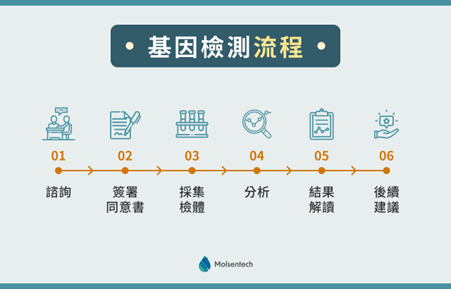
(2) Genetic Testing Workflow: 6 Simple Steps
- Consultation:Discuss testing goals and implications with a healthcare provider.
- Informed Consent:Review and sign consent documentation.
- Sample Collection:Provide biological samples such as saliva, blood, or oral swabs.
- Analysis:Laboratory testing using advanced detection technologies (biochip technology is recommended for higher sensitivity and efficiency).
- Result Interpretation:Receive a detailed report explaining genetic variations and health risks.
- Follow-up Recommendations:Personalized guidance on treatment, medication, or lifestyle adjustments.
5. Do You Need Genetic Testing? Key FAQs
What types of genetic diseases exist?
Monogenic disorders: Caused by mutations in a single gene (e.g., thalassemia, hemophilia). Polygenic disorders: Involve multiple genes and environmental factors (e.g., heart disease, hypertension, diabetes).
How should genetic test results be interpreted?
Positive: Genetic variation detected (does not guarantee disease occurrence) Negative: No variation detected (does not eliminate risk) Uncertain: Further research or monitoring required
Genetic testing reflects risk—not certainty. Lifestyle and environmental factors remain critical.
Who should consider genetic testing?
Individuals with family history of genetic diseases Couples planning pregnancy Pregnant individuals Patients with specific medical conditions Anyone concerned about long-term health
Is genetic testing safe?
Genetic testing itself is non-invasive and safe. However, different institutions may use technologies with varying levels of sensitivity and accuracy. Choosing a certified and advanced testing provider is essential.
Technology Advantage: Why Molsentech?
Molsentech’s biochip platform features tens of thousands of detection points, enabling comprehensive genetic analysis with high precision and speed—making it a preferred partner for many healthcare institutions.
6. The Era of Precision Medicine: Why Molsentech
As awareness of preventive healthcare grows, genetic testing is becoming an essential tool in modern medicine. It enables early risk detection and supports more precise treatment decisions.
Molsentech’s semiconductor-based biochip technology delivers faster, more sensitive, and more accurate results, increasing testing capacity while reducing turnaround time.
Key Advantages
✨ High Diagnostic Accuracy High-density chip design with tens of thousands of detection points supports multiple probes simultaneously, significantly improving accuracy.
✨ Reduced Time and Labor Costs A proprietary detection system integrating electrical signal processing and fluid automation enables real-time analysis, accelerating report delivery.
✨ Stable and Reliable Chip Performance Unique bio-coating technology enhances molecular stability and detection sensitivity. Advanced heterogeneous integration packaging minimizes sample clogging risks.
Molsentech’s COVID-19 nucleic acid detection chip has received emergency use authorization (EUA) from the Taiwan Food and Drug Administration, outperforming existing market solutions.
About Molsentech
Founded in 2014, Molsentech is dedicated to making precision diagnostics simpler. The company develops semiconductor biochip platforms based on nano-scale sensing technologies, with deep expertise in both hardware and software integration.
Looking ahead, Molsentech aims to make advanced diagnostics more accessible and real-time—driving innovation in healthcare and improving lives.
