

1. Why Consider Cancer Genetic Testing? A Tool for Early Prevention and Precision Medicine
According to the Cancer Registry Report published by Taiwan’s Ministry of Health and Welfare, approximately 51,000 people in Taiwan died from malignant tumors (cancer) in 2022, accounting for 24.91% of all deaths. Cancer remains a major threat to public health. As medical technology advances, genetic testing has become an important tool for helping physicians develop more precise, personalized treatment plans and assess an individual’s cancer risk.
(1) What Is Cancer Genetic Testing?
Cancer genetic testing analyzes DNA sequences to detect mutations and determine whether a person carries specific genetic variants. Examples include EGFR/ALK alterations in lung cancer and RAS and BRCA1/2 variants in breast cancer. This genetic information helps physicians assess cancer risk more precisely and develop more targeted treatment plans for patients who have already been diagnosed.
To help more cancer patients benefit from precision treatment through genetic testing, Taiwan’s Ministry of Health and Welfare added next-generation sequencing (NGS) testing to National Health Insurance coverage on May 1, 2024. Coverage included the following nine categories of solid tumors: non-small cell lung cancer; triple-negative breast cancer; ovarian, fallopian tube, and primary peritoneal cancers; prostate cancer; pancreatic cancer; solid tumors with NTRK gene fusions; intrahepatic cholangiocarcinoma; thyroid cancer; and medullary thyroid cancer.
(2) Two Main Uses of Cancer Genetic Testing
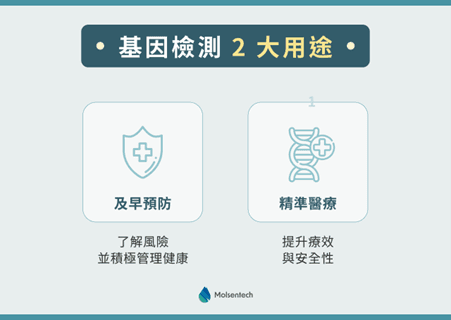 Cancer genetic testing serves two main purposes:
1. Early Prevention: Understand Risk and Manage Health Proactively
Cancer genetic testing helps people understand their cancer risk so they can take preventive action early. For example, women who carry breast cancer-related gene mutations may undergo regular breast screening, monitor genetic changes, and adjust their lifestyles to reduce cancer risk.
⚠️ Genetic test results provide information about health risks; they do not mean that a person will definitely develop a disease.
2. Precision Medicine: Improve Treatment Effectiveness and Safety
For people already diagnosed with cancer, genetic testing can inform personalized treatment recommendations and help predict drug metabolism and potential side effects. This helps physicians choose medications suited to each patient’s needs and supports precision medicine.
Historically, cancer treatment relied heavily on physicians’ clinical experience and statistical data, making it difficult to tailor treatment to individual patients. Genetic testing allows physicians to better understand a patient’s biological characteristics and mutations, enabling the development of drugs directed at specific targets in cancer cells while reducing side effects and benefiting more patients.
With more sensitive, faster testing technology, Molsentech helps optimize treatment plans.
2. What Types of Cancer Genetic Tests Are Available? Benefits, Limitations, and Uses
Cancer genetic tests can be divided into three types according to the number of genes analyzed: single-gene testing, focused gene panel testing, and broad gene panel testing.
| Single-Gene Testing | Focused Gene Panel Testing | Broad Gene Panel Testing | |
|---|---|---|---|
| Number of genes tested | One | Dozens | Hundreds |
| When it may be used | A known family history of disease and a need to confirm a specific genetic variant | • Poor response to treatment • Recurrent disease • Assessment of suitability for immunotherapy • Limited sample volume • A need for shorter testing times | • Insufficient sample volume • A desire for a comprehensive understanding of cancer risk or precision treatment options |
| Advantages | • Lower cost • Highly targeted analysis • Available at most hospitals | Can provide guidance for targeted therapy and immunotherapy | • The broadest testing scope • Potential to identify previously unknown genetic variants |
| Limitations | • Limited testing scope • Cannot comprehensively assess cancer risk | • Does not cover every possible cancer-related gene • May miss potential mutations | • Higher cost • Requires analysis by a specialist medical team |
1. Single-Gene Testing
Single-gene testing analyzes one specific gene at a time. For inherited conditions known to result from a single-gene variant, such as thalassemia or hemophilia, it can identify the variant more precisely. This approach provides information for assessing the likelihood of cancer and determining whether disease is present. Although highly targeted, its limited scope does not provide a comprehensive picture of potential cancer risk.
2. Focused Gene Panel Testing
Focused gene panel testing covers dozens of high-risk genes associated with cancer. It helps physicians assess a patient’s condition and develop more precise treatment plans, including guidance for targeted therapy and immunotherapy. When treatment response is poor or the disease recurs, this testing can help guide adjustments to the treatment strategy. Because focused panels generally examine known cancer-related genes, they may still miss potential genetic variants, even though they analyze more genes than single-gene tests.
3. Broad Gene Panel Testing
Broad gene panel testing, also called comprehensive genetic testing, examines hundreds of genes strongly associated with cancer. It can inform targeted therapy and immunotherapy and may identify mutations that have not yet been clearly classified, potentially supporting participation in clinical trials or innovative treatments. The efficiency and accuracy of genetic testing depend heavily on chip technology. Molsentech’s biochips are more sensitive and faster than other existing technologies, effectively detecting low levels of genetic mutations and helping healthcare institutions meet the needs of earlier diagnosis and precision medicine.
Make Molsentech your trusted partner for more efficient testing technology.
3. Who May Benefit from Cancer Genetic Testing? Five Key Groups
In addition to cancer patients, people at higher risk can use cancer genetic testing to identify potential risks early. The following five groups are recommended for consideration:
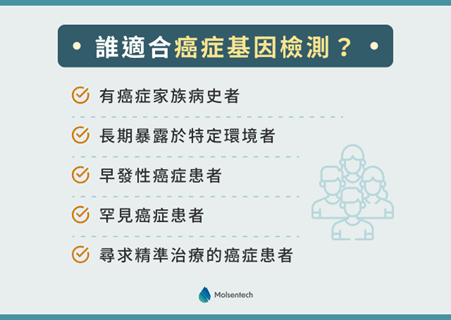
● People with a family history of cancer: If two or more family members have had the same cancer, or a relative was diagnosed before age 50, genetic testing is recommended to identify related mutations and support early preventive action.
● People with prolonged exposure to certain environments: Those exposed over extended periods to factors such as radiation or X-rays are advised to consider cancer genetic testing to assess their risk.
● Patients with early-onset cancer: People diagnosed with cancer at a young age are advised to undergo testing to identify inherited mutations, assess risks for family members, and develop personalized treatment strategies.
● Patients with rare cancers: Rare cancers are often associated with genetic abnormalities. Testing can help identify cancer-related genes, guide physicians toward more appropriate treatments, and potentially support participation in clinical trials to improve the likelihood of treatment success.
● Cancer patients seeking precision treatment: When treatment has limited effectiveness or the disease recurs, genetic testing can help physicians identify suitable targeted drugs or immunotherapies and improve the prospects of successful treatment.
4. More Efficient Cancer Genetic Testing with Molsentech
Cancer genetic testing has brought a major transformation to precision medicine. However, existing testing technologies can be time-consuming and labor-intensive. To address these challenges, Molsentech has developed more sensitive, faster biochips that substantially improve detection sensitivity while shortening the time needed to produce reports. This gives healthcare professionals more time to test patients who need it.
Our biochip technology brings new possibilities to cancer testing and treatment through three key advantages:
✨ Improved Diagnostic Accuracy
Our biochips incorporate advanced manufacturing processes to achieve a high-density layout of more than 10,000 detection sites. They can carry multiple types of biological probes simultaneously, substantially improving the precision of genetic testing results.
✨ Lower Labor and Time Costs
We independently developed the world’s first testing instrument to integrate electrical current signals with an automated fluidics system. It processes biological current signals from more than 10,000 detection sites per second and generates accurate results in real time. This enables healthcare institutions to provide analysis reports to patients sooner, significantly reducing labor and time costs and improving healthcare efficiency.
✨ Consistent Chip Quality
Our proprietary biological coating technology stabilizes molecular arrangement to improve testing reliability and sensitivity. Because biological sample testing demands stability and efficiency, we also use heterogeneous stacked packaging technology to reduce adhesion and clogging as specimens flow through the chip. Our COVID-19 nucleic acid testing chip has received Emergency Use Authorization (EUA) from the Taiwan Food and Drug Administration (TFDA), outperforming existing competing brands in the market.
Founded in 2014, Molsentech is committed to making precision testing simpler. We develop semiconductor biochip testing platforms that use nanoscale devices as sensors, drawing on extensive expertise in biochip development and the hardware and software of testing equipment. We aim to make precision testing faster and more accessible, advance medical technology in Taiwan, and create greater hope for public health.
Choose Molsentech biochips to bring greater hope to cancer patients.
